Showing posts with label Rich Pictures. Show all posts

Thursday, August 6, 2009

Insights from the Field: of "experts & "visual narratives".

Meeting “experts” and making “visual narratives” from the field


Prof. M P Ranjan

Image01: Four teams dealing with Water: Industry, Domestic, Agriculture and in Public Use – in front of their models that show the current level of understanding after having met experts in the field over the long weekend of research in the field.


Teams came back from the field work with rich insights about the topic that they had gone out to investigate through an active contact programme with “experts” in the field. These “experts” are not an academic category but include those people that the team members were able top locate who had a considerable amount of experience in the various sub issues that the team was seeking to learn about.

Image02: Views of the Water in Domestic space presentation showing the models and the rich elplanations made by the team members about the issues and perspectives that they had gleaned from their field research and meetings with experts.


Design uses knowledge that is available and what is available is processed deeply to bring a degree of understanding from which the design mind can launch the search for design opportunities, all visual, both ion the mind as well as in the visualisations that abound in the process that is used to bring clarity and to discover structure and meaning. The four groups met hoards of people in their search for experts in their particular domain and they came back enriched with new insights and many new discoveries and a fair degree of clarity about the domain that they had set out to research.

Image03: Team Industry had a rich visual narrative along with a fairly comprehensive structure to explain their findings from the field.


Learning about team work and about the value of images in this form of research was the key take away for the student teams at this stage of the DCC explorations. The metaphors made by these groups stil failed to capture the richness that was to be seen in the structure as well as the process diagrams from which the team had journeyed through. Perhaps a function of time available and the other activities that competed with the course, such as the Monsoon Fiesta, that coincides with the course at this time in the semester.

Image04: Views of the team presentation from the Water for Public Use.


Image05: Views from the Water for Agriculture team where for some reason the team has chosen a mechanical metaphor rather than a more appropriate organic one.


Prof. M P Ranjan

Wednesday, August 5, 2009

Visual Narratives: Learning from the Field

Rich Pictures in the Process of Understanding the Design Journey


Prof M P Ranjan

Image01: Group members drawing on a collective scroll laid out on the table while telling their story of meetings with informants in the field.


One group of students at Gandhinagar who were working on the theme of water and Industry came up with a rich visual narrative that is both interesting and makes sense. They had fanned out across Ahmedabad and Gandhinagar and some went out of town as well in search of people, who could be “experts”, who could explain the workings of the water processing and distribution systems of the city, with particular emphasis on what they had identified as industry applications, They came back after each day over the weekend in the field and shared their experiences and face to face encounters and meetings with the people on the ground and this was done in a visually rich manner.

Image02: Group members standing in front of the large scroll that they used by turns to share their insights from the field work carried out over three days in the field.


Each member of the group told their days story in a series of pictures that they laid out on a long scroll of paper that was both wide and long. They sat on the table and talked to each other as they drew the rich pictures on their own part of the sheet and having told their version of the story of the days meetings and the record of their journeys grows and spreads on the sheet. One other device that the group innovated was to draw a star at the point in their storytelling scroll to identify one new person in the journey of information and insight gathering that they had done that day.

Image03: Members came up to the scroll individually and told their story and shared the insights that they had gathered to make their more refined models and the final metaphor.


Having drawn the images they then linked the meta story that they had begun to understand from the growing diagrams on their large sheet of paper. Rich pictures helped in their internalizing the story and in preparing themselves for the presentation that would follow. Each team member came up to the sheet and talked with conviction about their part of the information gathering ventures into the field. Deep learning and clarity of expression gave the group a clear advantage when it came to sharing the findings with the larger group and the whole class was enthused with the breakthrough that the group had brought to the class.

Prof M P Ranjan

Saturday, October 6, 2007

Sustainability and Social Equity as a Design Challange in India

Undersdtanding the Known Universe: Assignment on Sustainability and Social Equity as a Design Challange in India

Images: Students sharing the work presentation at the end of assignment one in the DCC course at Bangalore.

The students of NID R & D Centre at Bangalore from the Retail Experience and Digital Experience disciplines were assigned the task of exploring the areas of three key sectors of employment to discover how the supply chain could be strengthened by design approaches to ensure both sustainability as well as social equity across the following sectors:

1. Handmade Products and Handlooms team with their models

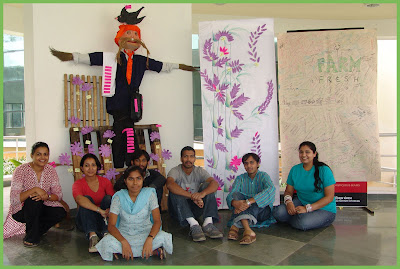
2. Farm Fresh Produce team with their models

3. Dairy and Poultry Products team with their models

The groups were asked to brainstorm and then categorise the various dimensions of these sectors so as to capture the known factors and attributes so as to understand the sector as a system which could then be inmproved from the stated goal of achieving both sustainability as well as social equity in the age of rapid globalisation and urbanisation that is sweeping the country today. This understanding was then to be used to develop design opportunities at a leter stage in the Design Concepts and Concerns course at the Bangalore Centre of NID. The two new disciplines at Bangalore are doing this course for the first time and the attempt is also being made to integrate the areas of focus of both groups at the Centre as well as the interersts of the students in each group. Groups were formed by choosing volunterr coordinators and they in turn selected the teams to make these multi-doisciplinary as well as with a gender balance in each group to get the required variety on the teams.

Image: Detail of one of the models by the Fresh Farm Produce Group

Each group made their brainstorming sessions with a lot of passion and committment and then spent a good deal of time in categorising their findings over a period of two days of intense activity. The teams then prepared a structure that made sense to them and based on the agreed structure they developed a rich metaphor to capture all the dimensions of their assigned sectors.

Rashmi, who is in Ahmedabad, shared a wonderful set of links from the Open University in the UK on Systems Modelling and Diagramming and the students have been requested to explore these links to study the theory of modelling and diagramming types through the rich multi-media presentations available at these links below:

What are Spray Diagrams?
What are Rich Pictures
What are Systems Maps?
What are Influence Diagrams
What are Multi-Cause Diagrams
What are Sign Graphs

These are not to be treated as frozen methods to be followed but as a guide to understanding and each experience will show the student their own way forward and give then an ability to make their own models and diagrams which are best suited to their task as well as one that can be achieved within the constraints of the skill sets available to the group with whom they are working.

Image: Teachers explaining the next assignment dealing with meetings with experts as well as strategies for gathering insights from the field.
 
Creative Commons License
This work is licensed under a Creative Commons Attribution-Noncommercial-No Derivative Works 2.5 India License.