Design thinking kit used by participants of the Earth Workshop to develop concepts through brainstorming and visualisation cycles. The resources for this kit can be downloaded from this link here - Design Thinking Kit for Earth Workshop as pdf files set.
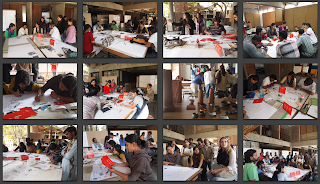
Student and craftsmen teams at the Earth Workshop design thinking session. Five groups used the Design Thinking kit and explored concepts on the visualisation sheets that were provided.
The day long session ended with the five teams making presentations of their concept sketches and scenarios before leaving for Kutch to work in a hands on manner with teams of master craftsmen at the Hunnarshala.
On their return to CEPT after five days in Kutch the team put up an exhibition of their explorations and proposed design solutions at the School of Interior Design's double height foyer and we had a de-briefing session that would help internalize the learning from the whole workshop and encourage reflection and documentation tasks that are to follow.
Image: Groups of students with their models and metaphors to explain their concept for the six proposed design schools for their chosen regions of India. We hope that the National Design Policy administrators are listening
The "Concept Mela format was used again after several years at the end of this DCC class for the Foundation students at NID. Media showed interest and many visitors interacted with the students. They are preparing a package that will be made available to policy makers and stake-holders alike. This is an attempt to create the future in design education, see the paper, "Creating the Unknowable: Designing the Future in Education" (2005) download pdf file here.
Prof. M P Ranjan Five years after the last major Concept Mela where NID Foundation students shared concepts for sector specific design institutions we have given the theme of designing six new schools for six regions of India – North, South East, West, Centre and Northeast regions.
Image01: Poster designed to invite feedback in the Concept Mela format at NID
The Concept Mela is scheduled to take place on 26th March 2010 in the NID Foyer and six groups composed of the 88 Foundation students from 3.00 pm tpo 6,00 pm IST. We look forward to a stimulating evening of presentations and discussions with visitors, students and faculty from NID and a number of other schools in Ahmedabad. The presentations will continue on the next day, Saturday 27th March 2010, from 10.00 am to 12.00pm.
Image 02: Students at work over the weekend at NID working on their respective concepts as well as in sessions with experts and teachers in their groups.
Learning from the field as a part of the design pedagogy at NID includes a live assignment that provides training in observation and interaction with persons and situations from a particular context. Here, in this course, we asked six teams of students to visit selected situations in the city of Ahmedabad to look at selected street food vendors over a period of three or four days in which they would watch, interact, record through field notes and sketches and build models to refine their understanding of the situation being studied, all carried out in an iterative manner. In this case the business models of a category of entrepreneurs called street food vendors. This year, as in previous years, we assigned the six groups to the categories of street food vendors who would be active at this time of the year. These six include – Fruit and Juice vendors (Juicewalla), Tea vendors (Chaiwalla), Pani Puri vendors (Pani Puri walla), Pav Bhaji vendors (Pav Bhaji walla), Omlette vendors (Omlettewalla) and the Fried Bhajiya vendor (Bhajiya walla). Download presentation with linked movies and paper titled "Creating the Unknowable: Designing the Future in Education" presented at the EAD06 conference in Bremen, Germany in 2005 which describes the course along with a visual presentation and embedded slide shows inside the pdf show. Zip file 53.8 mb with pdf show and full text and linked movies.
Image01: Metaphor chosen by the Juicewalla group was Street Car Racing with pit stops and racing events that were supported with poster presentations of a variety of juice vendors in the city of Ahmedabad. the thumbnail images show how the team members came up to the models and explained their understanding to the full class.
Image02: The Chaiwalla group chose the metaphor of a Football match and they presented a dynamic image that had players coming in as cut-out images and made for a compelling presentation. The team wore team T-shirts and badges for a group identity.
Image03: The Pani Puri group used the train of gears as their metaphor and theirs too was a dynamic show since they came in one by one and added a new yellow gear as they shared their insights from the field.
Image04: A very Indian metaphor of a Masala Dabba or Masala Box for Indian spices was used by the Pav Bhaji group and the show went through many layers of unfolding from each spice sub-box. The lid too had some problems that were shared at the very end.
Image06: Finally the Bhajiyawalla group stole the show by presenting an huge Ten Rupee Note using both sides of the note as their metaphor. Their explanation was that whatever happened to the costs of ingredients the Bhajiyawalla always managed to Price their product at Rupees Ten. Good insight from the field, a strategy to remember.
Understanding Business Processes: Building and delivering business models are now an integral part of our understanding of design in India. We therefore innovated this assignment in order to give design students an understanding of business processes. Groups of students are asked to study the work of local street food vendors and to conduct observations and interviews with numerous such service providers in order to understand their business processes and to map the same in the form of a presentation to the rest of the class. The local “Chai-wallah, the omlette-wallah, and other fast-food vendors on the streets of Ahmedabad become subjects of their study of micro-enterprises which have all the business processes and strategies of a multi-national, albeit at a much smaller scale, and at much more comprehensible scale of operation. Students build a visual model of their observations and findings along with a smattering of business terminology to explain the cash flows and business strategies adopted by each of these micro-enterprises and leads to a better understanding of business processes as an area of study. The presentations are used by the teachers to instruct and inform the students of the relevance of such studies and the possibility of scaling up this study to medium and large businesses in principle. This is perhaps a painless way to learn about business and the understanding exhibited by our students is quite remarkable.
Image01: DCC Black Board generated through class brainstorming on the key words associated with “What is Design?”
Once again we return to the Foundation batch at NID to conduct another course of the Design Concepts and Concerns and this year we have as many as 90 students in the Foundation year two batches since the NID student intake has once again expanded this year. There is another change in the time table this year to accommodate the Holi festival and we have agreed to have this course in two parts with the first part as a one week module that coincides with the NID Convocation week in early December 2009 and the second part as a four week module that comes after the Holi festival during the month of March 2010. We have therefore changed the sequence of assignments and tried to use the presence of over two hundred NID graduates on campus at Paldi who have all come to participate in the convocation ceremony. This would give the Foundation students an opportunistic occasion to meet them in an assignment format that would help them discover and articulate something more about the fields of design that they themselves would be entering at the end of their Foundation programme at NID.
Image02: Course introduction to teachers, course content and teaching approaches recorded in class and supplemented with images from the class on day one looking at the students in the class. Part one of the session as a YouTube movie based on the voice recordings in the class. Part one.
Learning by doing and learning through team work are the two major pedagogic strategies that the DCC course uses and these journeys are documented visually and these images are made available for future reflection so that learning is a continuous process, like a slow fuse still left burning as the semester progresses. The course teachers, Ranjan, Rashmi, Gayatri and Shashank met together and decided to use the NID Convocation event to place the Foundation students in a context where they could work as a team and find out as much as they could and in an as deeply connected manner as they could the many dimensions of the design disciplines that were offered at NID through an engagement with what they already knew and through meetings with senior students and graduates from the disciplines that they were assigned to study in some depth. The time available was les than a week since the students had still to put up their Convocation display for the Foundation Programme as part of the series of exhibits that were planned across the campus at NID. They therefore had their tasks cut out for them to plan their time and divide their tasks and work as a team to try and first discover the contents of the disciplines and then work together to visualize these into a coherent model that would help them share their collective understanding of the chosen subject with the rest of the class and the teachers at the end of the assignment.
Image03: Part two of the voice recording of the first session before the group brainstorming session supplemented with images from the class, this time looking at the teachers. Part two.
The course started with a round of introductions to the teachers and a morning of discussion on the topic of What is Design? The black board was used to capture brainstorming responses for students and as the black board filled up with words offered by the students the numerous dimensions of design came out in the open, as an external map of what was collectively held in the minds of the class fellows. Some of the words were new for some while others were more or less common for a class of the NID Foundation Programme student who had completed one semester of basic design education that dealt with composition, drawing, colour, geometry and materials – all foundations for a design career – and they had many a discussion with teachers and seniors in their past months at NID, in a rich design learning environmemt. The first part of this discussion is recorded in the two part voice recordings that have been supported by images from the class in the form of a quicktime slide show, however here the black board brainstorming session is yet to follow and at the end of this session the class was divided into six groups, each assigned at random, by pick of lots, to one of the six design disciplines that could be broadly described by the terms listed here: 3D Products, Image and Graphics, Fibres and Textiles, Exhibition and Space, IT and New Media and Motion Picture and Animation.
Image04: Three groups as seen on day one and later after their model building based on their collective exploration of the chosen disciplines of design.
The student teams went into a huddle and prepared themselves for the period of field based interviews with NID graduates with the specific aim of trying to understand the various dimensions of each of the disciplines, their tools, processes, knowledge and skill sets and attitudes and finer sensibilities, that each of these disciplines would need to process in order to work effectively in the space that they usually worked in. This collective process of exploration, brainstorming, articulation and expression bring with it a sense of dep understanding of the subject at hand and the whole process is quite memorable for all the participants, if they have immersed themselves in the process over the limited time period that was available at hand. The week went by very rapidly and at the end we had six very rich presentations that were played out in front of the whole class, and each presentation was recorded in images and voice capture and these were all made available for the students as digital files placed on the DCC2010 server on the NID intranet.
Image05: Three more groups as seen on day one and later after they had completed their group assignment of building models of the chosen disciplines of design.
The theme for DCC 2009 continues to be Water even though the precipitation has improved in the delayed stage of the monsoon in India but the damage has been done and many farmers and village inhabitants have lost their means of livelihood and they feel the crunch when the dry spell continues beyond a point of no return.
Image01: DCC2009 BlackBoard at the opening session at Paldi for the fourth batch of PG students from Ceramic Design, Furniture Design, Graphic Design and Film and Video Communications. Thye brainstorming session and participative exploration of the question of “What is Design?” resulted in a large list of words that students brought up during the session.
The session itself was lively and many of the words were accompanied by a brief explanation and with some examples that could clarify the context in which these words were being offered during the class discussion of the subject of understanding design as we know it today. We lost one day in this two week course since the opening Monday was a public holiday due to ID celebrations. However we felt that we could still forge forward and in the evening the students were asked to form three groups and try and categorise these words into a coherent structure that would make sense to themselves as well as to all of us.
Image02: Three models were created by the three groups (as yet unnamed and identified only as Group 1, 2 and 3) and they presented the structure that they had evolved overnight through group sessions and the three groups had different models to offer.
Group 1 had chosen the Newtonian colour wheel to try and arrange the words and they had a dramatic presentation with the colour wheel that was mounted on the ceiling fan!! And at the end they turned on the fan and we saw WHITE!!, at least in the centre…. The Group 2 used the NID symbol as their metaphor and for some reason they added a lot of gears in the diagrams and many of these did not fit each other, but their logic was impeccable and based on their dialogues that led them to describe the stages of design as – Need, Imagination & Decisions – NID and to add to the image they had a base that stood for Context and an outside gear (which did not fit) but stood for Change. Group 3 had a flow chart that was logical and echoed Prof Bruce Archers model of the design process and these transported us back to the early 60s and the mid 70’s when the design methods movement was taking shape with the thought leaders – Archer, Jones and Alexander – gave us interesting views of design as they had gleaned during their research and deliberations in the early days of design methods.
At the end of the presentations we drew lots to decide which of these groups would have the themes assigned for this batch (DCC2009 PG Paldi B4), namely – Ice, Steam and Drops – the sub-themes under water that they have to investigate through a process of sense making and understanding development. The process includes articulating what the group already knows about the theme, based on their three types of memory that have been built over a lifetime of experience. Direct experiences, Related experiences and Imagined experiences. Sensory knowledge, Knowledge acquired from others and from sources and the fantasies from their own imagination and dreams of the past. Tomorrow we will see the first stage presentations of all three groups and I look forward to it.
Image: Composite view of three groups of Bangalore DCC students across three stages of their explorations of the theme of the course, Water – Riivers and Streams, Lakes and Ponds, Aquifers and Wells. Top row: Aquifers and wells, Middle row: Lakes and Ponds, Bottom row: Rivers and Streams
This was a very stimulating week for me at Bangalore with the wonderful weather and the daily rains in the evening time. I was also multitasking and working on my paper for the Istanbul Conference in October 2009 and I used the weekend to prepare my first draft and crystalise the research that had been going on over the past two months or so. The teams from the three disciplines at the NID Bangalore joined the course and there was a great deal of enthusiasm that was visible and all students participated with huge contributions both individual as well as collective. The results were visible and the theme of water across the three chosen areas of focus that was given to the students of DRE, DDE and IID at Bangalore were dealing with water on our land: Flowing, Standing and Underground
All three assignments were carried out with great enthusiasm and the results were remarkable. The groups explored the structure of the problem and started as usual with what they already knew in their lifetime of experience through a process of brainstorming and articulation followed by many iterations of discovering structure and finding the categories that could make sense of all the dimensions that the groups had identified. The second stage was very rich with expert interactions in the city of Bangalore and field visits to get first hand feel of the issues and perspectives in the domain of water and its uses and the effects on both environment and people. The third stage of building design opportunities was quite massive with each group producing over five hundred sketch concepts across many categories of action that they felt would be needed and could produce value. These were presented and the last assignment of individual development of one design opportunity for more detailed exploration and scenario visualization was taken up on the last day of the class. Seeing the 1500 thumbnail concepts of how water issues could be addressed with design was indeed stimulating and we need to capture these for further work in the days ahead. However I had to leave town for Jaipur on Friday morning to be with the IICD, Jaipur at their second convocation on the 12 September 2009. Back at NID Ahmedabad on Sunday morning I am awaiting the images from this visualization task at Bangalore and I am sure we will see 45 rich concept explorations that are both imaginative as well as rooted in practical realities that we all face today. I look forward to seeing the last stage soon with data feeds from my co-teachers at Bangalore, Nijoo Dubey and Priyanka Choudhary.
Bangalore Group starts DCC with Water as their theme with focus on three subjects of 1. Lakes & Ponds 2. Rivers & Streams and 3. Aquifers & Wells.
Image01: DCC blackboard and white board after the discussion on what is design and a few design experts known to the student group. Most of the words were contributed to by students as part of the discussion on the question of “What is Design?” and who are the designer experts that you have heard about.
This helps break the ice and a good deal of discussion about design, its attributes and activities as well as the disciplines that it draws from are discussed as part of this session. It also helps set the stage for the set of assignments to follow.
Image02: View of the Class in the NID Bangalore conference room during the first session
Three groups were formed by assigning one student to each group from the photo list that is available in such a way that each group has and even distribution of members from each discipline. At Bangalore we have three disciplines at the PG level, namely, Design for Retail Experience, Design for Digital Experience and Information and Interface Design. The session at NID Bangalore was conducted in the Conference room with black boards, white boards and digital projectors used for the lecture presentations. The modules of Understanding Design (download pdf file) was followed by sharing the IDSA lecture titled “Giving Design back to Society: Towards a post-mining economy”. The models used were explained and after the lunch break, after much delay we reassembled and formed the groups. I intended to show the students my EAD06 lecture titled “Creating the Unknowable: Designing the Future in Education”, however fate intervened and the power supply failed us and we switched back to the white board and continued the description of the assignments and the team formation process. Lots were drawn to make the assignment of the groups to the chosen subject truly random. These presentation pdf files can be downloaded from the links above and below here: EAD 06 presentation pdf file and eight linked quicktime movies all as one single zip file 53 MB in size
Design Opportunity Mapping: Water in our lives across sectors of action
Image01: With a large image of the planet Earth and an exaggerated drop of water at the centre the water in industry team grouped their design opportunity thumbnails in four broad clusters. The individual scenarios were then drawn up and presented with each member coming forward to explain their concept and the associated scenario illustration.
The assignment of exploring and discovering a large number of possible approaches and opportunities in the product, systems and services space that impinges directly or indirectly on the area chosen by the group may be a good way forward, particularly since they would have gone through at least two rounds of exploring the field and understanding its dynamics and its structure. Through this assignment the students get a feel for the early stages of design thinking and action, particularly in visualizing potential design opportunities and in experiencing the articulation of scenarios in the formulation of design ideas and avenues for action. The structure of the design situation becomes clear through the brainstorming and categorization assignments that have been carried out by the groups and these have been shared with the whole class. Having done this and after having experienced the sorting and organizing for a good deal of time the student is quite clear in the mind as to what the particular sector holds and offers as well as what as an individual they would like to focus their subsequent efforts.
Image02: The design opportunities in the domestic use of water was shown in the form of bubbles from a fish, not a very effective image, but it helped the group organize their thumbnail representations into four or five broad clusters. The group members then came forward and showcased their individual scenarios with this large image as their backdrop.
This is an assignment that gives the group and the individual student an insight into how design opportunities are visualized in a number of iterative stages and it also gives them an insight into the role of external models and discourse with colleagues in the process of design exploration and conviction building when the process of form and structure discovery is still in progress. Visualisation with the use of draft thumbnails is introduced to the students at this stage. Since we are looking at quick and expressive external images that could capture a gist of what is passing through the mind of the student this stage does give all students a glimpse into the minds of their colleagues and it is a revelation when a huge variety of concerns get disclosed that are not usually present in the verbalizations and dialogues within the group.
Image 03: The group dealing with water in public spaces came up with an illustration of a railway train and they used the clouds of smoke from the train’s chimney to cluster the design opportunity thumbnails that they had developed as a team. This was then used as a backdrop to showcase their individual design scenarios to the rest of the class.
The variety that emerges in the expressive form of what may be seen as one single word concept is another lesson to be learnt here. Many student produce huge variety of concepts based on the same starting point and it is a clear showing that in design individual expression can be influenced by a very large number of personal factors as well as biases. With the use of a format provided all the students of each group settle down to make sketch proposals for what they felt could be an opportunity in the particular sector or area of work. In this case the students worked as groups looking at possible design opportunities in the four areas of focus that were assigned to them, namely, the role and impact of Water in the following areas of focus: 1. Water in Industry 2. Water in Domestic Use 3. Water in Public Use 4. Water in Agriculture
Image4: The last group dealt with water in agriculture. They used the literal clouds on top to show the raining down of design opportunities in four broad clusters or groups of ideas as design opportunity thiumbnails cascade down from the clouds above. The categories that they used include the farmer, the Government, water and issues, the headings unfortunately did not tell us very much about the contents below.
The individual scenarios were carried out on DIN A3 size sheet of paper so that the students could have adequate space to explore the idea through a number of iterations but not all the students understood the need for sequential drawings and the manner in which their thoughts could be captured as they occurred on a large sheet of paper. However after the presentations their understanding of the process of visualization and discovery was better that when they began, but still a long way to go, and this would need constant practice. Design learning is also a function of knowing and doing and the internalization of the process and the emergence of designerly ways of thinking and visualization can be seen to have begun but not as yet fully achieved. Individual student visualizations are shown in the images below and these are categorized into the four groups that they belonged to as listed in the image caption below.
1. Water in Industry
2. Water in Domestic Use
3. Water in Public Use
4. Water in Agriculture
Image 05: Stills from an online video offered by Nature Magazine about the water hot spot developing in western India with severe water stress and ground water depletion in the States of Rajasthan, Punjab, Harayana and Delhi which also happen to be the food bowl of India.
While the DCC course has been addressing the various issues of water in our lives across many domains and verticals we have constant news flows about the shortage of water coming from many sources. The latest one is the result of a six year long satellite based study conducted by a consortium of scientific institutions led by NASA. The alarming video can be watched at the Nature Magazine website at this link here. I have also made a separate post on my Design for India blog to raise the issues that this holds for the design community in India and how we can rally to address these real needs on the ground and how well we are currently prepared to face these realities. The blog post on this issue can be seen here at this link below. Design for India
Image01: Four teams dealing with Water: Industry, Domestic, Agriculture and in Public Use – in front of their models that show the current level of understanding after having met experts in the field over the long weekend of research in the field.
Teams came back from the field work with rich insights about the topic that they had gone out to investigate through an active contact programme with “experts” in the field. These “experts” are not an academic category but include those people that the team members were able top locate who had a considerable amount of experience in the various sub issues that the team was seeking to learn about.
Image02: Views of the Water in Domestic space presentation showing the models and the rich elplanations made by the team members about the issues and perspectives that they had gleaned from their field research and meetings with experts.
Design uses knowledge that is available and what is available is processed deeply to bring a degree of understanding from which the design mind can launch the search for design opportunities, all visual, both ion the mind as well as in the visualisations that abound in the process that is used to bring clarity and to discover structure and meaning. The four groups met hoards of people in their search for experts in their particular domain and they came back enriched with new insights and many new discoveries and a fair degree of clarity about the domain that they had set out to research.
Image03: Team Industry had a rich visual narrative along with a fairly comprehensive structure to explain their findings from the field.
Learning about team work and about the value of images in this form of research was the key take away for the student teams at this stage of the DCC explorations. The metaphors made by these groups stil failed to capture the richness that was to be seen in the structure as well as the process diagrams from which the team had journeyed through. Perhaps a function of time available and the other activities that competed with the course, such as the Monsoon Fiesta, that coincides with the course at this time in the semester.
Image04: Views of the team presentation from the Water for Public Use.
Image05: Views from the Water for Agriculture team where for some reason the team has chosen a mechanical metaphor rather than a more appropriate organic one.
Image01: Group members drawing on a collective scroll laid out on the table while telling their story of meetings with informants in the field.
One group of students at Gandhinagar who were working on the theme of water and Industry came up with a rich visual narrative that is both interesting and makes sense. They had fanned out across Ahmedabad and Gandhinagar and some went out of town as well in search of people, who could be “experts”, who could explain the workings of the water processing and distribution systems of the city, with particular emphasis on what they had identified as industry applications, They came back after each day over the weekend in the field and shared their experiences and face to face encounters and meetings with the people on the ground and this was done in a visually rich manner.
Image02: Group members standing in front of the large scroll that they used by turns to share their insights from the field work carried out over three days in the field.
Each member of the group told their days story in a series of pictures that they laid out on a long scroll of paper that was both wide and long. They sat on the table and talked to each other as they drew the rich pictures on their own part of the sheet and having told their version of the story of the days meetings and the record of their journeys grows and spreads on the sheet. One other device that the group innovated was to draw a star at the point in their storytelling scroll to identify one new person in the journey of information and insight gathering that they had done that day.
Image03: Members came up to the scroll individually and told their story and shared the insights that they had gathered to make their more refined models and the final metaphor.
Having drawn the images they then linked the meta story that they had begun to understand from the growing diagrams on their large sheet of paper. Rich pictures helped in their internalizing the story and in preparing themselves for the presentation that would follow. Each team member came up to the sheet and talked with conviction about their part of the information gathering ventures into the field. Deep learning and clarity of expression gave the group a clear advantage when it came to sharing the findings with the larger group and the whole class was enthused with the breakthrough that the group had brought to the class.
This interactive multi-author space has been set up as an experiment in online educational interactions as part of the teaching programme at NID within the Design Concepts & Concerns course conducted by Prof. M P Ranjan, Rashmi Korjan, Dimple Soni, Gayatri Menon and Rupesh Vyas. Other faculty, students and invited contributors have been requested from time to time to join as authors to explore the various dimensions of design processes and its design opportunities in India. The major themes that inform this course are discussed in greater detail in our advocasy blog Design for India at this link.
While this space is moderated by Prof. M P Ranjan, the views expressed by the individual authors are their own and it does not necessarily reflect the official views of the Institute.

 The day long session ended with the five teams making presentations of their concept sketches and scenarios before leaving for Kutch to work in a hands on manner with teams of master craftsmen at the Hunnarshala.


